
Beyond the Block: Why Triple-Washing and Cation Exchange are Non-Negotiable for Reptile Welfare
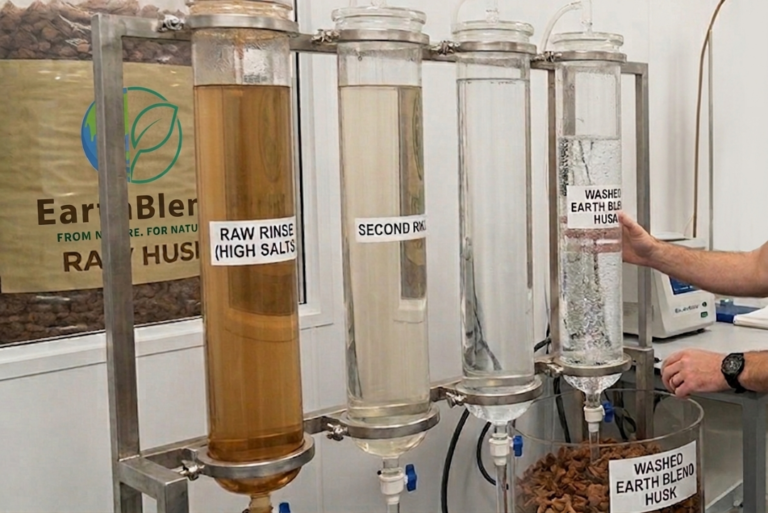
To the untrained eye, all coconut husk looks the same. To a biologist, however, the difference between “raw” coco husk and Earth Blend is a matter of chemistry.
If you’ve ever noticed “burning” on a reptile’s underside or a sudden, unexplained decline in plant health in a bioactive setup, you might be dealing with a hidden enemy: Residual Salts.
1. The Salt Trap: Understanding the Raw Resource
Coconut palms are naturally salt-tolerant trees that thrive in coastal areas. Because of this, raw coconut husks are naturally loaded with sodium and potassium.
The Problem: When these husks are processed cheaply, these salts remain trapped within the fibers.
The Welfare Risk: For a reptile—especially species with permeable skin like amphibians or young skinks—sitting on “salty” substrate is like sitting on a mild irritant. Through a process called osmosis, high salt concentrations in the substrate can actually pull moisture out of your animal’s skin, leading to chronic dehydration and “substrate burn.”
2. The Science of Cation Exchange (CEC)
Coconut fiber has a high Cation Exchange Capacity. In simple terms, the fiber acts like a magnet for minerals.
The Raw State: The “magnets” are currently holding onto Sodium (Na) and Potassium (K).
The Earth Blend Process: We don’t just rinse the husk; we use a specialized triple-washing process that “unplugs” the salt ions and replaces them with Calcium and Magnesium.
The Result: This creates a chemically buffered substrate that is safe for sensitive reptile bellies and acts as a perfect nutrient-ready base for live plants.
3. Tannins: Friend or Foe?
Raw coco husk is also rich in tannins, which turn misting water a dark “tea” color. While some tannins are antifungal, excessive levels in a closed system can become acidic and staining.
The Humane Balance: Earth Blend’s washing process reduces tannins to a biological “sweet spot.” You get the natural antifungal benefits without the acidic sludge that can irritate eyes and cloacal openings.
4. Protecting the “Hydration Gradient”
A clean, washed husk allows for a much more accurate “Hydration Gradient.” Because the fibers aren’t clogged with salt, they can absorb water more deeply and release it more slowly.
The Professional Standard: When you use Earth Blend, you aren’t just managing humidity; you are managing osmotic health. Protecting the animal’s skin barrier is the ultimate act of humane husbandry.
Conclusion: Purity is a Performance Metric
At Earth Blend, we believe that what we take out of the husk is just as important as what we put in. Triple-washing isn’t a luxury—it is a safety standard. By choosing a chemically balanced substrate, you are ensuring that your animal’s skin and your plants’ roots are supported by science, not stressed by salt.
For Veterinarians & Bioactive Specialists
Are you seeing signs of skin irritation or plant failure in your clients’ setups? Our technical data on salt-buffering can help.
[Download the Earth Blend Purity Report] | [Become an Authorized Earth Blend Retailer]
- Built by breeders. Trusted by professionals. Premium natural substrates for exotic pets.
Directory
© Copyright 2026 by Earthblend.co